
Posted:
November 6, 0026
The new Hydrogen Transport Forum white paper examines how hydrogen-powered transport is progressing globally and what Australia can learn from successful commercial deployments.

Hydrogen mobility is moving beyond demonstration projects into real-world commercial operations. From heavy-duty trucks in Switzerland to public transport fleets in Germany and large-scale infrastructure in China, international experience is demonstrating both the opportunities and challenges of hydrogen-powered transport.
The Hydrogen Transport Forum's (HTF) white paper, Hydrogen Mobility: Global Deployments and Implications for Australia, examines seven international markets to identify what drives successful hydrogen transport projects and how these lessons can inform Australia's transition to cleaner, more secure transport energy.
Drawing on operational data, infrastructure models and commercial experience, the report delivers a central message: hydrogen mobility is commercially operational in several international markets, but successful deployment requires coordinated investment, reliable infrastructure, committed fleet demand and supportive government policy.
Australia faces two significant transport challenges: reducing greenhouse gas emissions and strengthening national fuel security.
Transport accounts for approximately 23% of Australia's greenhouse gas emissions, while the country remains heavily dependent on imported petroleum products. Recent international supply disruptions have highlighted the vulnerability of Australia's freight and transport networks to global fuel markets.
Domestically produced hydrogen offers an opportunity to diversify Australia's transport energy supply while supporting emissions reductions.
Importantly, the white paper recognises that hydrogen and battery-electric vehicles can play complementary roles.
While battery-electric vehicles are increasingly suited to urban and depot-based applications, hydrogen offers potential advantages for long-distance freight, high-utilisation commercial vehicles and regional buses, particularly where rapid refuelling, payload requirements or limited charging infrastructure are important considerations.
The white paper examines hydrogen mobility developments across Switzerland, New Zealand, Germany, the United States, Japan, China and South Korea.
Each provides valuable insights into transitioning from trials to sustained commercial operations.
Hyundai's European XCIENT fuel-cell truck fleet had accumulated more than 20 million kilometres across 165 vehicles by January 2026. Switzerland's deployment demonstrates the value of coordinated infrastructure and innovative pay-per-use arrangements that reduce financial risk for operators.
Hiringa Energy's hydrogen refuelling network supports commercial freight operations across the North Island. A Hyundai XCIENT truck operating for NZ Post has exceeded 260,000 kilometres in scheduled service, with typical refuelling times of approximately 15 minutes.
Germany operates more than 600 hydrogen buses, including a 160-vehicle fleet operated by Regionalverkehr Köln. The experience demonstrates how hydrogen can support regional routes where operating distances and charging constraints challenge battery-electric alternatives.
California's NorCAL ZERO project deployed 30 hydrogen-powered heavy trucks alongside purpose-built refuelling and maintenance infrastructure. Its West Oakland station is designed to service up to 200 heavy-duty trucks daily, providing a model for Australian port precincts.
Japan is advancing hydrogen across passenger vehicles, buses and freight, including its first mass-produced fuel-cell heavy-duty truck in 2025.
China has recorded cumulative sales of nearly 40,000 fuel-cell vehicles and developed hundreds of refuelling stations, while South Korea's Hyundai-led ecosystem highlights the importance of manufacturing scale, government support and long-term investment.
Across the seven markets, the white paper identifies four consistent lessons.
The strongest finding is the importance of securing committed fleet customers before investing in refuelling infrastructure.
Successful deployments concentrate vehicles around shared infrastructure, creating sufficient demand to improve station utilisation and commercial economics.
Conversely, building isolated refuelling stations without reliable customer demand can result in underutilised infrastructure and higher fuel costs.
Hydrogen vehicles currently face higher upfront costs than diesel alternatives in many applications.
Innovative financing arrangements, including leasing, pay-per-use and performance-based contracts, can make adoption more accessible.
Switzerland's model demonstrates how transferring technology and residual-value risk away from individual operators can encourage fleet participation.
Projects have struggled when vehicles were introduced before dependable refuelling infrastructure was available, or when fuel supply disruptions reduced fleet availability.
The report highlights opportunities to use existing industrial hydrogen sources during the transition to larger-scale renewable hydrogen production, subject to lifecycle emissions assessment.
Hydrogen–diesel dual-fuel technology also provides a potential transition pathway, allowing existing heavy vehicles to reduce diesel consumption while hydrogen supply networks develop.
Successful international programs have benefited from government procurement commitments, targeted incentives and sustained infrastructure investment.
The paper highlights the value of linking public funding to measurable outcomes, including vehicle kilometres travelled, hydrogen dispensed and operational availability.
Crucially, hydrogen projects require long-term policy certainty rather than short funding cycles.
Building on these findings, the HTF proposes a three-phase roadmap.
Prioritise hydrogen hubs in Sydney and Melbourne, while supporting viable regional projects and freight corridors. The proposed national target is 15–20 operational refuelling stations and approximately 700–1,000 vehicles .
Expand successful deployments to approximately 25 operational stations, 1,200 vehicles and annual hydrogen consumption exceeding 2,000 tonnes by 2035.
Support broader deployment across interstate freight corridors and resources-sector logistics, guided by commercial demand, infrastructure readiness and viable economics.
These targets depend on coordinated industry investment, commercially acceptable hydrogen prices and government support.
The white paper calls for stronger collaboration between governments, vehicle manufacturers, hydrogen producers, infrastructure providers and fleet operators.
Key recommendations include co-investment in priority hydrogen hubs, government fleet procurement commitments, targeted financial support, performance-based incentives and a dedicated national hydrogen mobility strategy.
Established in 2025 by BMW, Hyundai and Toyota, the Hydrogen Transport Forum brings together vehicle manufacturers and technology providers to coordinate this transition.
The Forum aims to connect industry participants, aggregate fleet demand and help turn individual opportunities into commercially sustainable projects.
The international evidence demonstrates that hydrogen mobility is no longer simply a future possibility. Commercial vehicles are operating, infrastructure is expanding and technology continues to improve.
However, success depends on much more than vehicle technology.
For Australia, the opportunity is to apply these lessons strategically, focusing on applications where hydrogen can deliver genuine operational, environmental and energy security benefits.
The challenge is no longer simply proving that hydrogen-powered transport works. It is creating the conditions for it to work commercially at scale in Australia.
The HTF's white paper provides an evidence-based pathway to help achieve that goal.
Read the full white paper, Hydrogen Mobility: Global Deployments and Implications for Australia, to explore the international case studies, key findings and recommendations for Australia's hydrogen transport future:


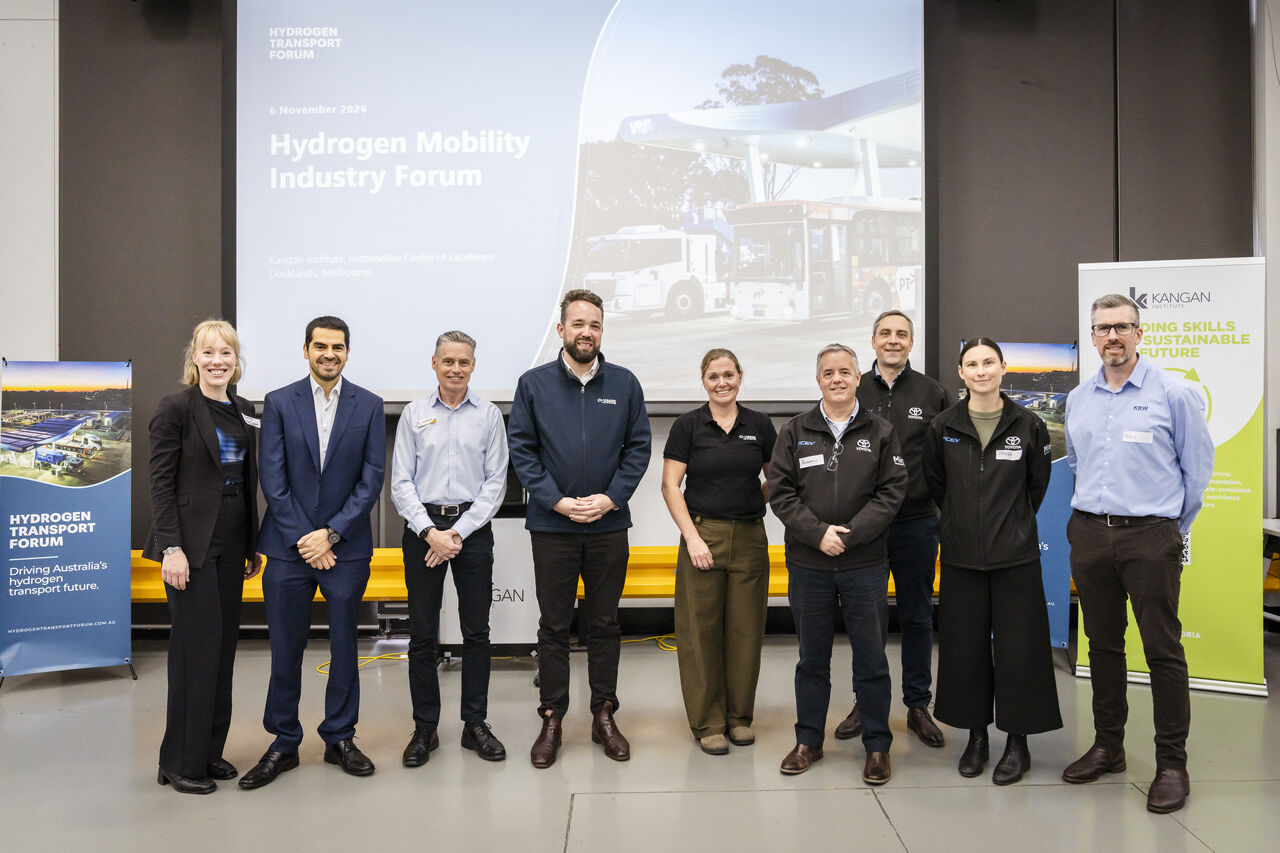
The 2026 Hydrogen Mobility Industry Forum brought together industry and government leaders to explore practical pathways for scaling hydrogen transport in Australia, highlighting the importance of coordinated fleet deployment, reliable refuelling infrastructure and international lessons.
read more
The HTF welcomes the National Cabinet’s focus on strengthening Australia’s fuel security.
read more
Global fuel instability highlights need for Australia to accelerate transition to hydrogen mobility.
read more
Foton Mobility Distribution and sister company, KRW Hydron join the HTF.
read more
New forum established to promote hydrogen transport solutions in Australia.
read more
Have a question for the Hydrogen Transport Forum? Get in touch.